
Donbas has become one of the most discussed regions in international news because of its central role in the Russia-Ukraine war. Located in eastern Ukraine, this historically industrial area is now at the center of major territorial disputes, military operations and international peace negotiations. Its future could influence Ukraine’s security, Russia’s regional ambitions and the wider political situation in Europe.
The region has attracted renewed attention in November 2026 following discussions about a possible Ukrainian withdrawal from parts of Donbas in exchange for NATO membership. Ukrainian President Volodymyr Zelenskyy has said that US negotiators raised this possibility during recent diplomatic discussions. However, Ukraine has maintained that it is not prepared to surrender its territory.
The disagreement highlights why Donbas remains such a difficult issue in efforts to end the war. Beyond its military importance, the region has a long history of coal mining, steel production, manufacturing and cultural development. Millions of people have connections to its cities and communities, making its future an important humanitarian as well as political concern.
Donbas Latest News: Why the Region Is Trending in November 2026
The latest developments surrounding Donbas are closely connected to renewed diplomatic efforts involving Ukraine, Russia and the United States.
On November 10 and 11, 2026, representatives from the three countries participated in US-mediated negotiations in Abu Dhabi. The meetings focused on possible ways to reduce the fighting, discuss security arrangements and address disagreements over territory.
One important outcome was an agreement in principle on a large-scale prisoner exchange. However, the negotiations did not produce a breakthrough on the main territorial dispute.
On November 14, Zelenskyy revealed that American negotiators had discussed a possible arrangement under which Ukraine could withdraw from Donbas in exchange for NATO membership.
Ukraine has not accepted the proposal. Zelenskyy indicated that any comprehensive agreement involving territorial questions would require strong security guarantees, military support and reconstruction funding. He also suggested that a major proposal could be presented to Ukrainian citizens through a national referendum.
The discussion is significant because Russia has repeatedly demanded control over the entire Donetsk and Luhansk regions, including areas that its forces do not occupy.
For Ukraine, withdrawing from Donbas could create serious security concerns. The region contains important defensive positions, communities and infrastructure that have remained central to the country’s resistance.
The November negotiations demonstrate that progress on humanitarian matters does not necessarily mean that a wider peace agreement is close.
ARTICAL: Warped Tour 2026: Latest Updates, Orlando Lineup, Tickets and Festival History
Where Is Donbas on the Map of Ukraine?
Donbas is located in eastern Ukraine, near the Russian border. The name is commonly used for the historical and industrial area associated with Donetsk and Luhansk oblasts.
The term comes from the words Donets Basin, referring to a large coal-rich geographical area that extends across parts of modern-day Ukraine and western Russia.
The region is not an independent country or a separate sovereign state. It is a historical, geographical and economic area within Eastern Europe.
Some of the most important cities associated with Donbas include:
- Donetsk: A major industrial city historically known for coal mining and steel production.
- Luhansk: An important manufacturing and engineering center.
- Mariupol: A strategic port city on the Sea of Azov with a significant steel industry.
- Kramatorsk: An industrial and administrative center in Donetsk Oblast.
- Sloviansk: A strategically important city connected to the early stages of the conflict in 2014.
- Bakhmut: A city that became internationally recognized because of intense fighting during Russia’s full-scale invasion.
These locations have different geographical and economic characteristics, but their connection to eastern Ukraine makes them important when discussing the wider Donbas region.
The History Behind Donbas: From Coal Mining to Industrial Power
The history of Donbas is closely connected to industrial development in Eastern Europe. Before becoming a major subject of international political discussions, the region was known for its natural resources, mining communities and manufacturing facilities.
The Industrial Revolution and Coal Mining
The development of modern Donbas accelerated during the nineteenth century when coal deposits attracted investors, engineers and workers.
Mining activities expanded as industrial demand increased. Railway connections helped transport coal and manufactured products to other parts of the Russian Empire.
Industrial settlements grew around mines, factories and transportation networks. Donetsk, historically known as Yuzovka, developed into an important industrial center.
The growth of coal mining also encouraged steel production and heavy engineering, establishing the region as an important economic area.
Donbas Under Soviet Rule
During the Soviet period, Donbas became one of the major industrial centers of the Soviet Union.
Large-scale industrialization expanded coal extraction, steel manufacturing, machinery production and chemical industries. Workers moved into the region from different parts of the Soviet Union, contributing to its diverse population.
Russian became widely used in many industrial communities, although Ukrainian cultural and linguistic traditions also remained part of regional life.
The Soviet industrial system shaped the economy, population and identity of Donbas for several generations.
What Changed After Ukraine’s Independence?
Ukraine became independent in 1991 after the dissolution of the Soviet Union.
Donbas remained part of independent Ukraine, but the transition from a centrally planned economy to a market-based system created serious difficulties.
Many industrial facilities were outdated and required modernization. Coal mines faced financial challenges, while factories struggled with changing international markets.
Economic uncertainty and political divisions became increasingly important in the region. These issues later contributed to the wider tensions surrounding eastern Ukraine.
Why Donbas Became the Center of the Russia-Ukraine Conflict
The modern armed conflict in Donbas began in 2014, following political upheaval in Ukraine and Russia’s annexation of Crimea.
After Ukraine’s political transition, armed separatist groups seized government buildings in parts of Donetsk and Luhansk. They announced self-proclaimed political administrations known as the Donetsk People’s Republic and Luhansk People’s Republic.
The Ukrainian government launched military operations to regain control over the affected areas.
The fighting developed into a prolonged conflict involving Ukrainian forces and Russian-backed separatist groups.
The Minsk Peace Agreements
International diplomatic efforts attempted to reduce the violence through agreements known as Minsk I and Minsk II.
Minsk I was signed in September 2014, while Minsk II followed in February 2015.
The agreements included ceasefire arrangements, the withdrawal of heavy weapons and political measures intended to establish a settlement.
Although they helped reduce fighting at different points, the agreements did not resolve the fundamental disagreements over territorial control and the political future of the region.
Russia’s Full-Scale Invasion in 2022
On February 24, 2022, Russia launched a full-scale invasion of Ukraine.
The Donbas region became one of the most important areas of military operations. Russian forces attempted to capture additional territory in eastern Ukraine, while Ukrainian forces defended major cities and strategic positions.
The fighting caused extensive destruction to residential areas, industrial facilities, transport networks and public infrastructure.
Mariupol became one of the most prominent examples of the devastation caused by the invasion. The city’s prolonged siege and destruction attracted international attention.
Since then, Donbas has remained central to military operations and diplomatic discussions.
Donetsk and Luhansk: Two Regions at the Center of the Dispute
Donetsk and Luhansk are the two Ukrainian administrative regions most closely associated with Donbas. Both have significant historical, economic and strategic importance.
Donetsk Oblast
Donetsk Oblast has historically been one of Ukraine’s most important industrial areas.
Its economy developed around coal mining, steel production, machinery and manufacturing. The city of Donetsk became a major industrial center, while Mariupol was known for its port and steelmaking facilities.
During the war, several locations in Donetsk Oblast became important military objectives. Kramatorsk, Sloviansk and other communities have strategic value because of their transportation connections and geographical positions.
The region continues to feature prominently in discussions about Russia’s territorial demands and Ukraine’s defensive strategy.
Luhansk Oblast
Luhansk Oblast lies northeast of Donetsk and shares a border with Russia.
The region historically supported coal production, chemical manufacturing, engineering and other industrial activities.
Its administrative center, Luhansk, developed into an important manufacturing city.
The region became involved in the 2014 conflict and later experienced major changes following Russia’s full-scale invasion.
Although Russia claims the entire oblast, its political claims should not be confused with internationally recognized Ukrainian borders or actual military control.
Why Donbas Matters for Military Strategy and European Security
The importance of Donbas goes beyond its industrial history. Its geographical position makes it an important part of the wider security situation in Eastern Europe.
The region’s proximity to Russia creates military and transportation considerations for both countries.
Control over its territory could influence defensive positions, supply routes and future military planning.
For Ukraine, maintaining secure positions in eastern Donbas is important because any territorial withdrawal could affect its ability to defend other parts of the country.
For Russia, gaining additional territory would support its wider military and political objectives in Ukraine.
The dispute also concerns European security because a potential settlement could influence future relationships between Russia, Ukraine, NATO and European countries.
The NATO Membership Question and Its Connection to Donbas
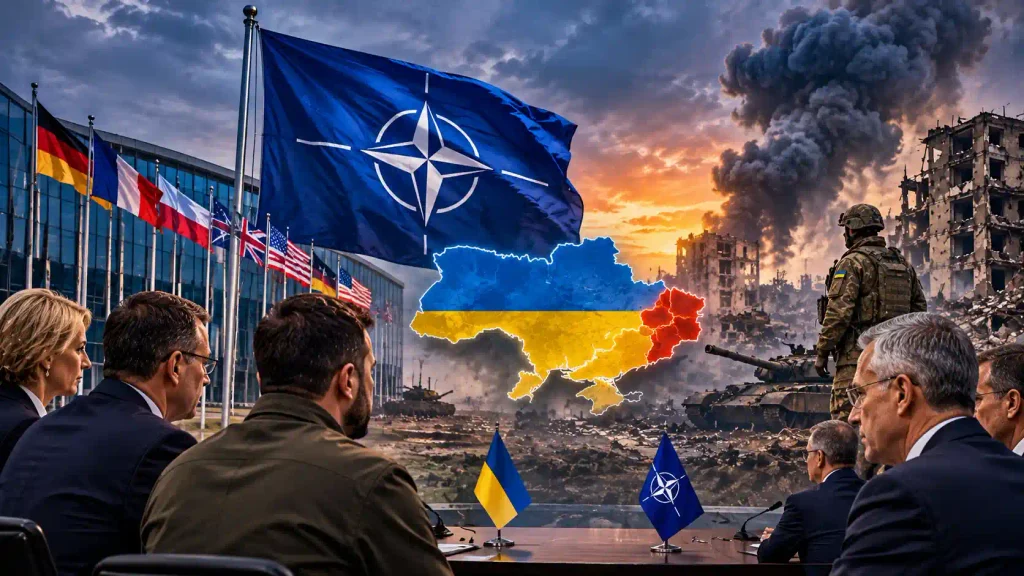
NATO membership has become an important part of discussions about Ukraine’s future security.
Ukraine has sought stronger international security guarantees following Russia’s invasion. Its relationship with NATO has therefore become closely connected to diplomatic efforts to end the conflict.
The November 2026 discussions brought this issue back into the spotlight after Zelenskyy said American negotiators had raised a possible link between Ukrainian withdrawal from Donbas and NATO membership.
However, several challenges remain.
Russia opposes Ukraine joining NATO and has repeatedly raised concerns about the alliance’s presence near its borders.
Ukraine, meanwhile, argues that it needs reliable protection against future Russian aggression.
European countries also have an important role in the discussion because changes to the security structure of Europe could affect the entire continent.
The question is therefore not simply whether Ukraine could receive NATO membership. It also involves the timing of security guarantees, the future of occupied territories and the conditions required for a lasting peace.
How the War Has Changed Donbas’s Economy
Before the conflict, Donbas was a major contributor to Ukraine’s industrial economy.
Its coal mines, steel plants, chemical factories and engineering facilities supported employment, exports and manufacturing.
However, years of conflict have severely disrupted these industries.
Many industrial facilities have suffered damage, while others have experienced production interruptions or lost access to important transportation routes.
Coal mining has also faced serious difficulties because of damaged infrastructure, security risks and changing economic conditions.
The consequences extend beyond large factories. Small businesses, local shops, transportation companies and service providers have also experienced economic disruption.
Rebuilding the region will require investment in modern industries, energy systems, transportation and public services.
The Human Cost of the Donbas Conflict
The impact of the war on ordinary people is one of the most important parts of the Donbas story.
Years of fighting have forced families to leave their homes and disrupted access to essential services.
Many communities have experienced damage to residential buildings, schools, hospitals and public infrastructure.
People living near frontline areas may face shortages of electricity, heating, water and medical supplies.
Displacement has also created difficulties for children, older people and families who have lost their homes or employment.
Another major challenge concerns property rights and reconstruction in occupied areas. Residents who return after years of displacement may face uncertainty about housing, documentation and access to basic services.
A lasting settlement will therefore need to consider more than military control. It will also need to address civilian safety, humanitarian assistance and the long-term recovery of affected communities.
What Could the Future of Donbas Look Like?
The future of Donbas will depend on developments on the battlefield and the progress of international negotiations.
A ceasefire could reduce violence and create opportunities for humanitarian assistance. However, it would not automatically settle the question of territorial sovereignty.
A broader agreement would need to address several difficult issues, including:
- The future status of territories currently occupied by Russia.
- Security guarantees for Ukraine.
- International monitoring of any ceasefire.
- The rights of displaced residents.
- Reconstruction of damaged cities and industrial facilities.
- Future relations between Ukraine, Russia and European countries.
The November 2026 negotiations show that both sides can discuss humanitarian issues, but major disagreements remain over territory and security.
Even if a peace agreement becomes possible, restoring Donbas will take years of investment and reconstruction.
Frequently Asked Questions About Donbas
What Is Donbas?
Donbas is a historical and industrial region in eastern Ukraine, mainly associated with Donetsk and Luhansk oblasts. Its name comes from the Donets Basin, a geographical area famous for coal deposits, steel production and manufacturing. The region is now internationally recognized because of its role in the Russia-Ukraine war.
What Is the Donbas Region Known for Today?
The region is known for its industrial heritage, coal-mining history and strategic importance. Before the conflict, it was an important center for Ukraine’s steel and manufacturing industries. Today, international attention is largely focused on military developments, territorial disputes and peace negotiations.
What Will Happen If Ukraine Loses Donbas?
If Ukraine loses control of the remaining parts of Donbas, it could face significant territorial, military and economic consequences. Russia could gain additional strategic positions, while Ukraine might lose important defensive locations and industrial assets. Such an outcome could also influence future peace negotiations and Ukraine’s security arrangements. The actual consequences would depend on the circumstances and terms of any agreement.
Why Does Russia Want Donbas?
Russia wants Donbas because of its strategic location, historical industrial resources and political importance. Control over the region would support Russia’s military position in eastern Ukraine and its wider territorial objectives. The Kremlin also considers Donetsk and Luhansk central to its demands in negotiations. Ukraine rejects these claims and maintains that Donbas is part of its sovereign territory.
Where Is the Donbas Region Located?
The Donbas region is located in eastern Ukraine, close to the Russian border. It is mainly associated with Donetsk and Luhansk oblasts, although the wider geological Donets Basin extends into other parts of Ukraine and Russia. Important cities connected to the region include Donetsk, Luhansk, Mariupol, Kramatorsk and Sloviansk.
Conclusion
Donbas remains one of the most important regions in the Russia-Ukraine war because its future is connected to territorial sovereignty, military strategy, economic recovery and European security.
The latest November 2026 developments have brought renewed attention to the region, particularly after discussions about a possible Ukrainian withdrawal in exchange for NATO membership. However, Ukraine has not accepted surrendering its territory, and the main disagreements between Moscow and Kyiv remain unresolved.
Understanding Donbas requires looking beyond daily military updates. Its industrial history, geographical importance, political background and humanitarian challenges all help explain why the region matters.
As peace negotiations continue, developments in Donbas will remain important for Ukraine, Russia and the wider international community.
SOURCE: Wikipedia
You May Also Like
 Kaylee Hottle: Godzilla Actress, Deaf Family, Movies and Latest News
 NBIS Earnings: Latest Results, Stock Price, AI Growth and 2027 Forecast
 Lorenzo Sonego: Biography, ATP Ranking, Latest News and Career Achievements
 CRWV Stock: Price, Latest News, Earnings, AI Growth and Future Outlook
 CoreWeave Stock: Price, Latest News, Earnings, AI Growth and Future Outlook
 Veterans: Military History, Benefits, Veterans Day 2026 and Latest Updates