
NVIDIA has become a major force in the global technology industry, driven by its graphics processors, artificial intelligence systems and advanced computing platforms. The company initially built its reputation in computer gaming, but its technology now supports some of the world’s most advanced AI applications, cloud services and data centers.
As artificial intelligence continues to develop, NVIDIA has attracted attention from technology enthusiasts, businesses and investors. Its graphics processing units (GPUs) are used to train AI models, process large amounts of information and power applications such as chatbots, autonomous vehicles and intelligent robots.
The company’s growing influence has also increased interest in its leadership, ownership, financial performance and business partnerships. People frequently search for NVIDIA’s CEO, founder, stock price, relationship with Google and investment in OpenAI.
However, understanding NVIDIA requires looking beyond its graphics cards. Its AI infrastructure, Blackwell architecture, next-generation Vera Rubin platform and competition in the semiconductor industry are equally important.
This guide explains what NVIDIA does, how it makes money, who runs the company and what its latest developments mean for the future of artificial intelligence and technology.
What Is NVIDIA and What Does the Company Do?
NVIDIA is an American technology company specializing in graphics processing units, AI computing, networking and accelerated computing software. Its headquarters are located in Santa Clara, California.
Founded in 1993, NVIDIA originally focused on developing graphics technology for personal computers and gaming systems. Its GeForce graphics cards helped the company become a recognizable name among gamers and computer enthusiasts.
Today, its business extends into several industries:
- Artificial intelligence: Developing processors and platforms for training and operating AI models.
- Gaming: Producing graphics cards that improve gaming performance and visual quality.
- Data centers: Supplying computing systems used by cloud providers and large technology companies.
- Automotive: Supporting autonomous driving research and intelligent vehicle technology.
- Robotics: Providing computing platforms for intelligent machines and industrial automation.
- Healthcare: Supporting medical imaging, drug discovery and scientific computing.
NVIDIA’s importance has increased because modern AI applications require enormous computing power. Its GPUs can perform many calculations simultaneously, making them particularly useful for machine learning and other demanding workloads.
This has transformed the company from a graphics hardware manufacturer into a major supplier of artificial intelligence infrastructure.
ARTICAL : Jennifer Garner: Biography, Movies, TV Shows, Family and Latest News (2026)
Who Is Jensen Huang and Why Is He Important to NVIDIA?
Jensen Huang is NVIDIA’s co-founder, president and chief executive officer. He has led the company since its establishment in 1993.
Born in Taiwan, Huang moved to the United States during his childhood. He studied electrical engineering at Oregon State University and later earned a master’s degree from Stanford University.
Before founding NVIDIA, he worked at LSI Logic and Advanced Micro Devices. His experience in the semiconductor industry helped him recognize the potential of specialized processors.
Huang played an important role in expanding NVIDIA beyond gaming graphics cards. Under his leadership, the company invested in GPU computing, AI software, data centers and advanced networking technology.
He is also known for introducing major NVIDIA products and developments at technology conferences. His presentations often attract attention because announcements about new processors and AI systems can influence the wider semiconductor industry.
His leadership remains closely connected to NVIDIA’s long-term strategy of developing complete computing platforms for artificial intelligence.
Who Founded NVIDIA and When Did It Start?
NVIDIA was established on April 5, 1993, by three founders: Jensen Huang, Chris Malachowsky and Curtis Priem.
The founders shared a vision of improving computer graphics through specialized hardware. At the time, gaming and multimedia applications were becoming more demanding, creating opportunities for better graphics processing technology.
The company’s introduction of the GeForce 256 in 1999 was a major milestone. NVIDIA marketed the product as the world’s first GPU, helping establish a new category of computer hardware.
Over the following years, the company expanded into professional visualization, scientific computing and artificial intelligence.
One of the most important developments was CUDA, a software platform that allowed developers to use NVIDIA GPUs for general-purpose computing rather than graphics alone.
This technology helped create the foundation for NVIDIA’s later success in AI.
Who Owns NVIDIA? Understanding Its Shareholders
NVIDIA is a publicly traded company, which means ownership is distributed among shareholders.
Its shares trade on the Nasdaq stock exchange under the ticker symbol NVDA.
Jensen Huang is a significant shareholder, but he does not personally own the entire company. Other shareholders include institutional investors, investment management firms and individual stockholders.
Major institutional investors have included Vanguard, BlackRock and State Street.
Their ownership percentages can change as shares are purchased or sold.
For investors, this public ownership structure means NVIDIA stock can be bought and sold through brokerage accounts without purchasing the entire business.
How NVIDIA Makes Money Across Different Industries
NVIDIA generates revenue through the sale of GPUs, AI computing systems, networking products and software technologies.
Its business is divided into two main reportable segments: Compute & Networking and Graphics.
The company’s products serve several markets:
Business area Products and services
Data Center AI GPUs, networking and computing systems
Gaming GeForce graphics cards
Professional Visualization RTX workstation technology
Automotive DRIVE computing platforms
Robotics AI computing and simulation systems
Data Center has become the largest part of NVIDIA’s business because cloud providers and AI developers need powerful processors to train and operate advanced models.
Gaming remains important, while professional visualization, automotive and robotics offer additional opportunities.
According to NVIDIA’s fiscal 2026 annual report, revenue reached approximately $215.9 billion, representing 65% annual growth. The company’s Data Center business accounted for approximately $193.7 billion in revenue.
These figures demonstrate how strongly artificial intelligence and accelerated computing have influenced NVIDIA’s business.
NVIDIA GPUs and the AI Technology Behind Its Growth
NVIDIA’s graphics processing units are central to its position in the technology industry.
A CPU is designed to handle a wide variety of general computing tasks, while a GPU can perform many calculations in parallel. This makes GPUs useful for applications that require processing large amounts of data.
AI models depend on these calculations to identify patterns, generate responses and process information.
NVIDIA develops several important GPU families and computing architectures.
GeForce RTX: These graphics cards are designed for gaming, content creation, ray tracing and AI-powered graphics features.
Hopper: This architecture includes H100 and H200 data center GPUs used for AI training and high-performance computing.
Blackwell: NVIDIA’s Blackwell architecture supports advanced AI computing, generative AI and large-scale data center applications.
Vera Rubin: This next-generation platform is designed to support increasingly demanding AI workloads, including advanced reasoning and agentic AI.
These technologies help NVIDIA serve both individual computer users and some of the world’s largest technology companies.
Why NVIDIA Blackwell and Vera Rubin Matter
Blackwell and Vera Rubin are important because the computing requirements of AI systems continue to increase.
Modern AI applications need more than a single processor. They often require thousands of connected GPUs, high-speed networking and specialized software.
Blackwell is designed to provide computing power for large-scale AI infrastructure. Its systems combine processors, networking and other technologies to support demanding workloads.
Vera Rubin represents the next stage of NVIDIA’s computing roadmap. It is intended to improve the performance and efficiency of advanced AI systems.
These platforms are particularly relevant as companies develop AI agents, reasoning models and applications that process increasingly complex tasks.
For NVIDIA, successful product transitions could help maintain demand for its computing infrastructure.
What Is NVIDIA’s Relationship With OpenAI?
NVIDIA and OpenAI are important companies in the artificial intelligence ecosystem.
OpenAI develops products such as ChatGPT, while NVIDIA provides GPUs and computing systems that support AI model training and operation.
In September 2025, the companies announced a strategic partnership involving plans for at least 10 gigawatts of NVIDIA computing infrastructure.
The original announcement also included an intended investment of up to $100 billion from NVIDIA, linked to the deployment of computing capacity.
However, the original proposal should not be confused with an investment that has already been completed in full.
The relationship developed further in 2026, when OpenAI announced a $110 billion funding round that included a $30 billion investment from NVIDIA.
The partnership is important because advanced AI models require significant computing resources. NVIDIA supplies hardware, while OpenAI develops AI products and applications.
Both companies have an interest in expanding the infrastructure needed for future AI development.
How Google and NVIDIA Work Together
Google and NVIDIA are separate companies, but their technologies work together in cloud computing and artificial intelligence.
Google Cloud offers access to NVIDIA GPUs, allowing businesses to run demanding AI applications without purchasing and maintaining their own physical servers.
These services can support:
- Machine learning development
- AI model training
- Generative AI applications
- Scientific research
- Large-scale data processing
- Cloud computing workloads
Google also develops its own Tensor Processing Units, known as TPUs, which are designed for machine learning tasks.
This creates a relationship involving both cooperation and competition. Google uses NVIDIA technology in its cloud ecosystem while also developing alternative AI computing hardware.
Google does not own NVIDIA, and the two companies operate independently.
NVIDIA Stock: What Investors Should Understand
NVIDIA trades on the Nasdaq under the ticker symbol NVDA.
The stock attracts attention because the company is closely connected to the growth of AI, data centers and semiconductor technology.
Its financial results can influence investor expectations about the future of the AI industry.
For fiscal 2026, NVIDIA reported:
Financial metric Result
Total revenue $215.9 billion
Annual revenue growth 65%
Gross margin 71.1%
Operating income $130.4 billion
Diluted earnings per share $4.90
These figures reflect strong growth during the company’s fiscal year.
However, investors should not evaluate NVIDIA stock using revenue growth alone. Its valuation, operating costs, competitive position and future demand also matter.
Important developments that could affect its stock include new GPU launches, AI infrastructure spending, export restrictions and financial guidance.
A successful technology business does not automatically represent a good investment at every market price.
NVIDIA’s Latest Developments in November 2026
NVIDIA remains an important company to follow because developments involving its products, leadership and AI partnerships can influence the wider technology market.
One major development on November 8 and 9 involved an independent investigation announced by NVIDIA’s board.
The investigation followed reports that CEO Jensen Huang may have been targeted by a foreign intelligence effort. NVIDIA stated that its board had no reason to believe national security or company secrets had been compromised.
The board expressed confidence in Huang and said he would cooperate with the investigation.
The reports created uncertainty among investors, and NVIDIA shares fell in premarket trading on November 9.
Other important developments include the expansion of AI infrastructure, the Blackwell and Vera Rubin computing roadmaps, and the continued development of partnerships with major cloud and AI companies.
These developments show that NVIDIA’s business is influenced by both technological progress and wider business and regulatory conditions.
For the latest official announcements, investors and readers can follow NVIDIA’s newsroom and financial reports.
NVIDIA’s Competitors in the Semiconductor Industry
NVIDIA has a strong position in AI computing, but several companies are developing competing technologies.
AMD: Competes through Radeon graphics cards and Instinct AI accelerators.
Intel: Develops processors, graphics technology and AI computing products.
Google: Offers its own Tensor Processing Units for AI workloads.
Amazon: Develops Trainium and Inferentia chips for its cloud computing services.
NVIDIA’s advantage comes from more than its processors. Its CUDA software platform, networking products and established developer ecosystem also help differentiate its technology.
However, competition could increase as companies look for alternative processors that reduce costs or improve efficiency.
How AI, Robotics and Autonomous Vehicles Could Shape NVIDIA’s Future
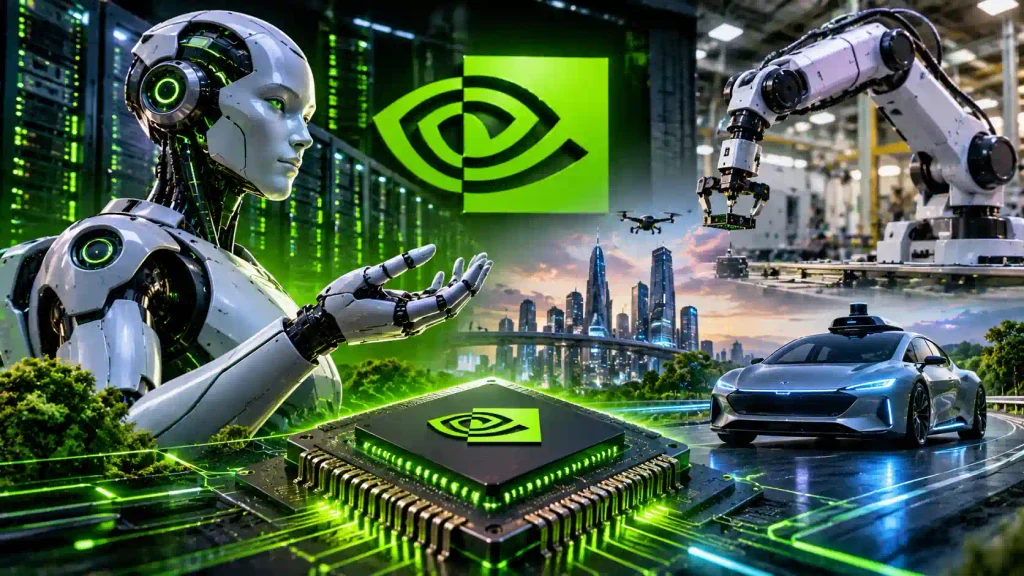
Artificial intelligence is not the only area creating opportunities for NVIDIA.
The company is also investing in technologies that connect AI with physical machines and real-world applications.
Agentic AI: These systems can perform multiple steps, use software tools and complete complex tasks. Their development may increase demand for computing infrastructure.
Robotics: NVIDIA’s Isaac platform supports the development, simulation and training of intelligent machines.
Automotive: Its DRIVE platform provides computing technology for advanced driver assistance and autonomous vehicle development.
Digital twins: NVIDIA Omniverse helps businesses create virtual environments for simulating factories, machines and other physical systems.
Healthcare and research: Accelerated computing can support medical imaging, scientific simulations and drug discovery.
These markets could provide additional growth opportunities, although their commercial development will depend on adoption, cost and technological progress.
Risks That Could Affect NVIDIA’s Business
Despite its strong position, NVIDIA faces several challenges.
- Competition from AMD, Intel and specialized AI chip developers.
- Dependence on external semiconductor manufacturing partners.
- Export restrictions affecting certain international markets.
- High energy and infrastructure requirements for AI data centers.
- Changes in technology company spending.
- Possible shifts toward alternative computing architectures.
Investors and technology users should consider these challenges when evaluating NVIDIA’s long-term position.
Frequently Asked Questions About NVIDIA
How to Update NVIDIA Drivers?
You can update NVIDIA drivers through the NVIDIA App or by downloading the latest compatible version from the company’s official website.
For Windows computers, follow these steps:
- Open the NVIDIA App.
- Navigate to the Drivers section.
- Select Check for Updates.
- Download the available driver.
- Follow the installation instructions.
- Restart your computer if necessary.
NVIDIA offers two common driver options.
Game Ready Drivers are designed for gamers who want optimized support for new games and updates.
Studio Drivers are designed for content creators who use applications for video editing, animation, 3D design and other professional workloads.
You can also manually select your graphics card model and operating system through the official NVIDIA driver download page.
Always download drivers from an official NVIDIA source to avoid incompatible or unsafe software.
What Is NVIDIA Used For?
NVIDIA develops GPUs, AI processors and computing platforms used in gaming, artificial intelligence, data centers, robotics, scientific research and autonomous vehicle technology.
Its products help computers process graphics and perform complex calculations more efficiently.
When Does NVIDIA Report Earnings?
NVIDIA reports financial results every quarter.
Its next scheduled earnings announcement is November 17, 2026, covering the third quarter of fiscal year 2027.
The company has scheduled its financial results conference call for 2 p.m. Pacific Time, or 5 p.m. Eastern Time.
Investors can follow the announcement through NVIDIA’s official investor relations website.
When Is NVIDIA Earnings?
The next scheduled NVIDIA earnings date is November 17, 2026.
The report will cover the quarter that ended October 25, 2026.
Investors will be watching revenue, earnings per share, Data Center performance and management’s outlook for future business growth.
These results could provide useful information about demand for AI processors and the company’s Blackwell computing systems.
Why Is NVIDIA Stock Going Down Today?
On November 9, 2026, NVIDIA shares came under pressure after the company’s board announced an independent investigation involving CEO Jensen Huang.
The investigation followed reports that Huang may have been targeted by a foreign intelligence effort.
Reuters reported that NVIDIA shares fell nearly 5% in premarket trading following the development.
Several factors may influence the stock’s movement:
- Leadership uncertainty: Investors may be concerned about the investigation and its potential implications.
- Market sentiment: Technology stocks can experience volatility when investors become cautious about AI spending.
- Upcoming earnings: Traders are watching NVIDIA’s November 17 results for information about business performance.
- Competition: Investors continue to evaluate competition in AI processors and data center infrastructure.
- Profit-taking: Some shareholders may sell after periods of strong stock performance.
NVIDIA’s board has stated that it has no reason to believe company secrets or national security were compromised. The investigation remains an ongoing development.
A decline in the stock price does not necessarily mean the company’s underlying business has weakened. Investors should distinguish between short-term market reactions and long-term financial performance.
Final Thoughts
NVIDIA has grown from a graphics technology startup into a major supplier of artificial intelligence and accelerated computing infrastructure.
Its GPUs, CUDA software platform, data center systems and AI partnerships have helped make it an important part of the modern technology ecosystem.
The company’s relationship with Google, OpenAI and other major technology businesses demonstrates how essential advanced computing has become.
At the same time, competition, manufacturing requirements, export restrictions and changing AI investment trends remain important challenges.
For anyone researching technology companies, AI developments or the semiconductor market, NVIDIA is a company worth understanding. Its future will depend on continued innovation and its ability to maintain demand for its computing platforms.
SOURCE: wikipedia
You May Also Like
 Colorado: Complete Guide to Population, Cities, Weather, Attractions and Latest Trends (2026)
 Sophie Cunningham: Age, Partner, WNBA Career, Height and Latest News (2026)
 Ross Lynch: Wife, Age, Marriage News, Movies and Music Career (2026)
 Crude Oil Prices Today: Brent, WTI, Global Oil Market and 2026 Outlook
 Bruce Springsteen: Biography, Age, Wife, Songs, Career and Latest News (2026)
 Golden State Valkyries: WNBA Champions, Players, History and Latest News
One Response